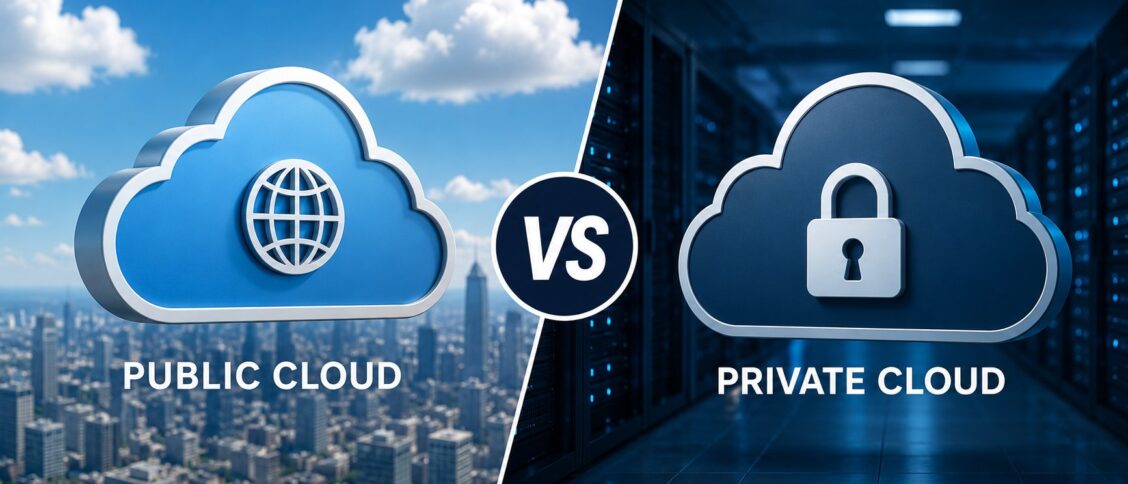
Public vs private cloud is one of the foundational distinctions in cloud computing, and it’s a question that comes up early in any serious cloud strategy discussion. The two deployment models share the same underlying technology pattern (on-demand virtualized infrastructure, API-driven provisioning, elastic scaling) but differ in who operates the infrastructure and who has access to it. Public cloud means infrastructure operated by a major cloud provider and shared across many customers; private cloud means cloud-style infrastructure dedicated to a single organization, either operated by the organization itself or by a dedicated provider. The choice between them shapes cost structure, security posture, operational complexity, and what’s actually feasible to build.
This post walks through what each model actually means, the trade-offs that consistently matter, the hybrid and multi-cloud patterns that combine them, and how to think about the choice for an organization figuring out where to land.
What public cloud actually means
Public cloud is the model most people mean when they say "the cloud." A small number of major providers (Amazon Web Services, Microsoft Azure, Google Cloud Platform, and a longer tail including Oracle Cloud, IBM Cloud, Alibaba Cloud, and smaller providers like DigitalOcean, Linode, and Vultr) operate large fleets of data centers and offer compute, storage, networking, databases, and hundreds of other services on demand. Customers sign up, provision resources through APIs or web consoles, and pay for what they use.
The defining features of public cloud:
- Multi-tenant infrastructure: customers share the underlying physical hardware, with strong logical isolation between them. Virtualization technology and provider-level network segmentation keep customers’ workloads separated even when they run on the same physical machines.
- On-demand provisioning: new resources come up in minutes through self-service interfaces. No hardware procurement, no capacity planning lead times.
- Pay-as-you-go pricing: usage-based billing, with no commitment to specific capacity. Some workloads benefit from reserved-capacity discounts; the underlying model is consumption-based.
- Massive scale and service breadth: major public clouds offer hundreds of distinct services covering compute, storage, databases, networking, security, machine learning, analytics, developer tools, and many specialized domains. The breadth makes them platforms, not just infrastructure.
- Global reach: data centers in many countries, allowing customers to deploy workloads close to their users without managing the underlying real estate.
For most organizations starting cloud strategy from scratch in 2025, public cloud is the default choice for most workloads. The combination of scale, capability, and pay-as-you-go economics is hard to match.
What private cloud actually means
Private cloud means cloud-style infrastructure operated for a single organization. The "cloud" part of private cloud is what distinguishes it from traditional on-premises IT: same self-service provisioning, same API-driven operations, same elasticity within the allocated capacity, but operated as a dedicated environment rather than a shared one.
Private cloud comes in several flavors:
- On-premises private cloud: the organization owns the hardware and operates the cloud stack itself, typically using software like VMware vSphere/vRealize, OpenStack, or one of several commercial private-cloud platforms.
- Hosted private cloud: a managed-service provider operates the cloud stack on the organization’s behalf, often in dedicated hardware in the provider’s data center.
- Dedicated cloud regions: some major public cloud providers offer dedicated regions or instances where the underlying hardware is exclusive to a single customer. AWS Outposts, Azure Stack, and Google Cloud Dedicated are examples of patterns that bring cloud capabilities into customer-controlled environments.
Private cloud was much more common in the late 2010s than it is today. The economic and capability gap with public cloud has widened, and many organizations that started with private cloud have migrated workloads to public cloud over time. Private cloud still has its place, particularly for regulatory contexts, certain large enterprises with steady predictable workloads, and organizations with specific data-residency requirements that public cloud regions can’t address.
The trade-offs that consistently matter
Several axes consistently distinguish the two models.
Cost. Public cloud is typically cheaper for variable workloads and for organizations without the scale to amortize private infrastructure efficiently. Private cloud can be cheaper for very predictable, very steady, very large workloads where the organization can fully utilize dedicated capacity. The cost crossover point varies by workload type, but most organizations find public cloud is the cheaper option for most workloads at most scales.
Capability breadth. Public cloud has substantially more capability available, faster. New services, new instance types, new specialized hardware appear continuously. Private cloud offerings are inherently slower to adopt new capability because the customer has to deploy and operate each new service themselves.
Operational responsibility. Public cloud handles a meaningful portion of the operational work (hardware maintenance, hypervisor patching, low-level infrastructure operations). Private cloud puts more of that responsibility on the customer, even when the cloud-style abstractions are present.
Security posture. This is the most contested axis. The intuition that "private = more secure" is partially right and partially wrong. Public cloud providers invest enormously in security and typically have more security expertise and more sophisticated controls than any individual customer could build. But shared infrastructure introduces specific risks (side-channel attacks, hypervisor vulnerabilities) that don’t exist in dedicated environments. Private cloud removes the shared-infrastructure risks at the cost of putting more security responsibility on the customer. The right answer depends on the specific threat model.
Compliance and data residency. Some regulated industries (specific government workloads, certain healthcare and financial contexts, defense work) have requirements that effectively mandate private or dedicated cloud. Most regulated workloads can be served by public cloud’s compliance-certified regions, but the specific requirements vary by industry, country, and contract.
Vendor independence. Public cloud at scale creates dependency on the chosen provider. Migrating off a major public cloud after deep adoption is expensive and slow. Private cloud (and certain multi-cloud patterns) reduce this dependency at the cost of giving up some of the convenience that drove the original adoption.
Performance characteristics. Public cloud performance is excellent and predictable for most workloads. For very specific high-performance or low-latency requirements, private infrastructure can sometimes deliver better predictability because there’s no noisy-neighbor effect from other customers sharing the hardware.
Hybrid and multi-cloud (the patterns that combine them)
Real-world cloud architectures rarely choose strictly one model. Two patterns combine them.
Hybrid cloud mixes private and public cloud (or public cloud and on-premises), with workloads distributed across both based on fit. Hybrid is common in enterprises that have substantial existing on-premises infrastructure plus growing public cloud adoption. The combination lets them keep workloads where they fit best rather than forcing everything into one model.
Multi-cloud uses multiple public cloud providers (running some workloads on AWS, others on Azure, others on Google Cloud). Multi-cloud is often pursued for resilience (no single-provider outage takes everything down), vendor leverage (avoiding deep dependency on one provider), capability differences (specific services that are better on specific providers), or organizational reasons (different teams have different preferences).
Both patterns add complexity. Operating across two or three different cloud environments requires teams skilled in each, tooling that works across them, and operational discipline to keep them coordinated. The complexity is real but often worth it for the specific benefits.
For small and mid-sized businesses, neither hybrid nor multi-cloud is usually the right starting point. Single-provider public cloud (typically AWS, Azure, or GCP) is simpler to operate and sufficient for most workloads. Hybrid and multi-cloud become meaningful patterns at enterprise scale, in regulated industries, or for specific strategic reasons.
How to think about the choice
For a small or mid-sized business deciding where to land, the practical framing:
Start with the workload, not the model. Different workloads have different needs. A customer-facing web application has different requirements than an internal HR system has different requirements than a data warehouse. Pick the right hosting for each workload rather than trying to force everything into one model.
Default to public cloud for new workloads. Unless there’s a specific reason not to (regulatory requirement, deep existing on-premises investment that the new workload needs to integrate with, specific performance or cost analysis that points elsewhere), new workloads typically belong in public cloud in 2025.
Migrate legacy gradually. Existing on-premises workloads that work fine where they are don’t need to migrate just because cloud is fashionable. Migrate when there’s a specific business reason (hardware refresh due, application modernization, capacity constraints) and the public cloud target is genuinely better than the current state.
Be honest about what private cloud is for. Private cloud genuinely serves specific use cases (certain regulatory contexts, very predictable steady workloads at enterprise scale, organizations with strong philosophical preference for dedicated infrastructure). It doesn’t make sense purely because "cloud" is in the name; the question is whether the dedicated model actually fits the workload better than the public alternative.
Plan for the operational reality. Whatever model you choose, the operational discipline (security configuration, cost management, monitoring, incident response) is what determines whether the deployment works. Picking a model is the easy part; operating it well is harder.
Frequently Asked Questions
Is public cloud less secure than private cloud?
Not inherently. Public cloud providers invest more in security than almost any individual customer could match, and typically have stronger physical security, more sophisticated threat detection, and broader compliance certifications. The security questions in public cloud are about customer configuration (misconfigured storage buckets, weak access controls, exposed credentials), not about the underlying infrastructure. Private cloud removes the shared-infrastructure risks but puts more of the security work on the customer. Neither model is universally more secure; it depends on the specific threat model and the customer’s operational maturity.
Is public cloud always cheaper than private cloud?
No, though it usually is for variable workloads at small-to-mid scale. For very predictable, very steady, very large workloads, private infrastructure can be cheaper because dedicated capacity can be fully utilized. The break-even point depends on workload type and scale. Many organizations that did the analysis carefully and chose private cloud for cost reasons in the late 2010s have since reconsidered as public cloud pricing has continued to improve.
Can I run the same applications on public and private cloud?
For most modern applications, yes, with some adjustments. Applications built with containers (Docker, Kubernetes), portable databases, and standard open-source components run on either model with relatively modest changes. Applications that depend heavily on provider-specific services (proprietary databases, specific managed services, vendor-locked frameworks) are harder to migrate between models. The discipline of building for portability has a real cost in convenience but pays back in flexibility.
What’s the difference between private cloud and on-premises?
On-premises traditionally means dedicated hardware operated for a single organization with traditional IT operational patterns (manual provisioning, ticket-based capacity requests, multi-week lead times for new resources). Private cloud means the same dedicated hardware operated with cloud-style patterns (self-service provisioning, API-driven operations, elastic capacity within allocated limits). The hardware can be identical; the operational model is different. Private cloud essentially brings cloud’s operational benefits to dedicated infrastructure.
Should a small business use private cloud?
Usually no. Private cloud has significant operational overhead that’s hard to justify at small-business scale. The cost, complexity, and capability gap with public cloud usually makes public cloud the better choice for organizations under a few hundred employees. Exceptions exist (specific regulatory requirements, very specific workload patterns, organizations with strong existing investments in private infrastructure), but the default answer for small business is public cloud or SaaS, not private cloud.