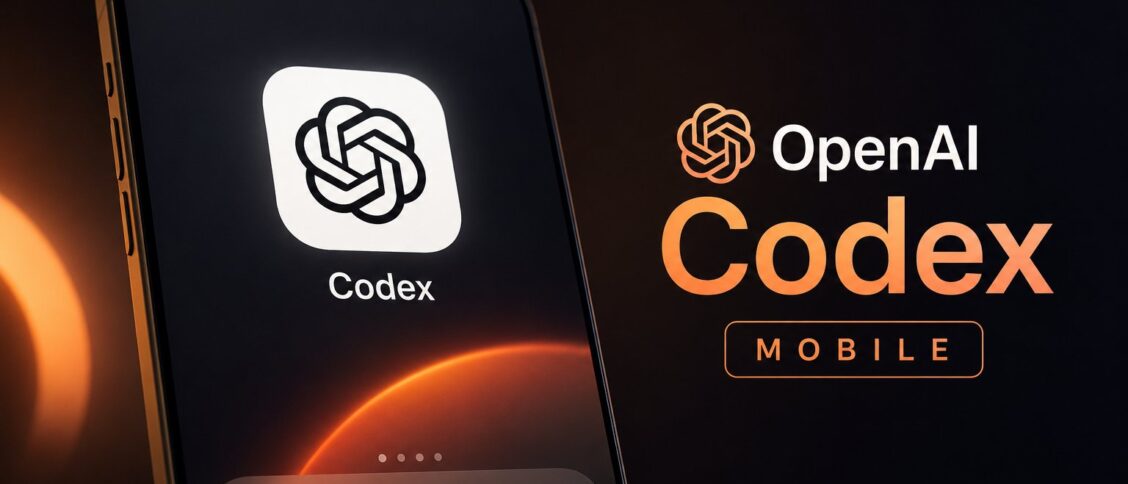
OpenAI Codex mobile went live today. On Thursday, May 14, 2026, OpenAI announced that its Codex coding agent has been integrated into the ChatGPT mobile app on iOS and Android, in preview, across every ChatGPT plan including Free and Go. The function is available now in all supported regions. Codex itself does not move to the phone; the phone becomes a remote viewer and approval surface for Codex sessions running on a Mac (Windows support is "coming soon").
For development teams that already use Codex on desktop, the practical change is that the developer no longer has to be sitting at the machine where Codex is working. Active tasks, approvals, diffs, and terminal output stream to the phone. New tasks can be kicked off from anywhere. This post unpacks what’s actually new, what the companion announcements (Remote SSH GA, Hooks GA, programmatic access tokens, HIPAA-compliant Codex) mean in context, and how the move fits OpenAI’s broader coding-agent push against Anthropic’s Claude Code.
What "Codex on mobile" actually is
The mental model that matters is "remote control, not port." Codex continues to run where it has been running (a laptop, a Mac mini, a devbox, or now a remote SSH environment). Files, credentials, permissions, and local setup all stay on that machine. The mobile app loads live context from the running session: project context, approvals, plugins, screenshots, terminal output, diffs, and test results.
OpenAI framed the capability in its own statement, quoted by TechCrunch: "This is more than the ability to remotely control a single task or dispatch new tasks to your computer. From your phone, you can work across all of your threads, review outputs, approve commands, change models, or start something new." The framing matters because a naive read of the headline ("Codex on your phone") would suggest OpenAI shipped a coding-agent runtime for iOS and Android. That isn’t what happened. The runtime stays on the machine. The phone shows up as a control surface, with full visibility into the work the agent is doing.
The preview currently supports iOS and Android phones connecting to a Mac running the latest Codex app, per OpenAI’s documentation. Windows support is on the roadmap. For teams whose developers run Windows-only setups, the practical impact is "coming," not "now."
What you can do from the phone
The launch capability set, drawn from OpenAI’s announcement materials and 9to5Mac’s coverage:
- Switch between active task threads: every Codex thread running on the machine is visible from the phone. You can move between them, pick up context, and return to where you left off.
- Review what Codex has produced: diffs, file changes, terminal output, screenshots from any visual work, and the agent’s narration of what it did and why.
- Approve commands: when Codex pauses for approval (running a destructive command, calling an external tool, making a network request), the approval surface comes to the phone. Tap to approve, edit, or reject.
- Switch models mid-task: useful for cost-management workflows where the developer wants a thinking-tier model for the planning step and a cheaper tier for the execution step.
- Start something new: kick off a new task on the connected machine from the phone. Useful for the “I just thought of the bug” moment when the developer is away from the desk.
The thread you should not draw from the feature list is "Codex on mobile replaces a developer workstation." It does not. It replaces the constraint that the developer has to be sitting at the workstation to supervise a long-running agent. For agents that run thirty minutes to several hours per task (which is increasingly the operational pattern), that constraint was the binding one.
The companion announcements
The mobile launch shipped alongside a set of capability moves on the Codex platform that matter on their own:
- Remote SSH now generally available: Codex can connect into approved remote development environments that have company dependencies, credentials, security policies, and compute resources already configured. This is the enterprise-shaped capability for organizations where developer machines are deliberately not the place where production code is built or where production credentials live.
- Hooks now generally available: programmatic hooks let Codex behavior be customized at well-defined points in the agent loop (pre-tool-call, post-output, on-error). The use case is policy enforcement that doesn’t require a heavyweight wrapper around the agent.
- Programmatic access tokens for Business and Enterprise plans: Codex can be invoked from CI pipelines and release workflows with token-based authentication. This closes the gap between Codex as a developer tool and Codex as part of an automated build pipeline.
- HIPAA-compliant Codex for eligible ChatGPT Enterprise workspaces in local environments: Codex usage inside healthcare-adjacent organizations had been a procurement friction point. With HIPAA compliance available for eligible workspaces, that friction drops.
The four announcements share a theme. OpenAI is hardening Codex from a developer-productivity tool into a platform component that fits inside enterprise engineering org constraints: SSH-based access patterns, hookable runtime, token-based automation, and compliance gating. The mobile launch is the visible piece; the four companion announcements are the substrate.
How this fits the coding-agent race
Codex on mobile is the second mobile-control surface to ship for an enterprise-grade coding agent in 2026. Anthropic released Remote Control for Claude Code in February 2026 with structurally similar capabilities: monitor Claude Code’s work from afar, approve actions, steer tasks without sitting at the machine. The two products are now competing on a feature surface that did not exist eighteen months ago.
The chronology over the past sixty days is the more useful frame:
- April 16, 2026: OpenAI gave Codex the ability to run in the background in desktop environments, letting it take on long-running autonomous tasks rather than turn-by-turn collaboration.
- Early May 2026: OpenAI launched a Chrome extension for Codex, letting the agent operate inside live browser sessions.
- May 11, 2026: OpenAI launched Daybreak, the cybersecurity platform built on Codex Security and GPT-5.5 tiers.
- May 14, 2026: Codex lands in the ChatGPT mobile app with the companion enterprise-grade capability set.
That is four meaningful Codex platform moves inside thirty days. The competitive read is that OpenAI is moving aggressively to close the operational-pattern gap that Claude Code opened by going first on long-running, background-capable agents. Our AI Agents practitioner’s guide covers the underlying capability shift from chatbots to agents; the Codex moves are the OpenAI product-line embodiment of that shift.
The narrower competitive frame matters less than the operational frame. Two of the largest AI labs both now ship a mobile-control surface for their coding agents. That tells you the work cadence (long-running tasks where the developer needs to be reachable but not seated) is the new default, not an edge case.
What this means for development teams
For small and mid-sized engineering organizations evaluating the impact:
It is genuinely a workflow change, not a feature. A developer who can approve Codex’s destructive commands from a coffee shop can let Codex run a refactor that takes two hours without being held hostage to it. The unit of supervision shifts from "developer-attended task" to "task with checkpoints that surface to the supervisor." That is a meaningful change in the ergonomic pattern of how a senior engineer’s day is structured.
The companion enterprise capabilities are the deeper signal. Remote SSH GA, Hooks GA, programmatic access tokens, and HIPAA compliance are the gates that compliance and security teams use to greenlight or block a Codex rollout. Organizations that were waiting on those gates before they could ship Codex broadly internally have most of those gates resolved as of May 14.
The Windows-soon caveat matters more than the mobile-now headline. For developer organizations on Windows (which is the modal enterprise developer setup outside of strongly Mac-dominant tech companies), the preview is interesting but not yet operational. The clock on broad adoption starts when Windows support ships.
The competition is good for buyers. With both Codex and Claude Code shipping mobile-control surfaces in 2026, the operational pattern (long-running supervised agents controllable from a phone) is no longer vendor-specific. Locking in to either platform on this capability alone is harder to justify than it was four months ago. For broader context on OpenAI’s product evolution, our piece on ChatGPT-4o traces the trajectory from chat model to platform.
Frequently Asked Questions
Is OpenAI Codex mobile a free feature?
Yes. The Codex integration in the ChatGPT mobile app is available across all ChatGPT plans, including Free and Go, in all supported regions, as of the May 14, 2026 launch. The feature is in preview during this rollout. Codex itself still runs on a developer machine; the mobile app is the control surface, so the underlying Codex usage continues to follow whatever plan-tier usage rules apply on the machine where it runs.
Does Codex actually run on my phone now?
No. The Codex runtime continues to run on a desktop machine (a Mac, in the current preview). The phone is a remote viewer and approval surface. Files, credentials, permissions, and local setup stay on the machine. This is the same architectural pattern Anthropic used for Claude Code’s Remote Control feature in February 2026; running an enterprise-grade coding agent’s full execution stack on a phone is not feasible today, and shipping a remote-control surface is the pragmatic alternative.
Does the mobile feature support Windows machines?
Not yet. The May 14, 2026 preview supports iOS and Android phones connecting to a Mac running the latest Codex desktop app. OpenAI has stated Windows support is “coming soon” without a specific date. For developer teams running Windows-only setups, the practical recommendation is to monitor the Codex changelog for Windows support before planning a Codex mobile rollout.
How does Codex mobile compare to Anthropic’s Claude Code Remote Control?
Anthropic released Remote Control for Claude Code in February 2026 with structurally similar capabilities (remote monitoring, approval flow, task steering). Codex mobile launched May 14, 2026 with comparable functionality plus a broader companion launch (Remote SSH GA, Hooks GA, programmatic access tokens, HIPAA-compliant Codex for eligible workspaces). The two products are now competing on overlapping feature surfaces. For an organization evaluating either, the differentiator is less the mobile surface itself than the surrounding platform (model choice, enterprise compliance posture, pricing, ecosystem integrations).
What’s different about Codex on mobile versus other ChatGPT mobile features?
The ChatGPT mobile app already supported chat with the standard ChatGPT models. Codex mobile is different in two ways. First, it connects to a coding agent runtime running on a separate machine, not a chat interaction with a model. Second, the mobile app surfaces agent-specific affordances (approving commands, switching threads, reviewing diffs and terminal output, switching models per task) that don’t exist in the standard chat experience. Functionally, it is the developer-control surface for a separate Codex process, surfaced inside the ChatGPT app shell.