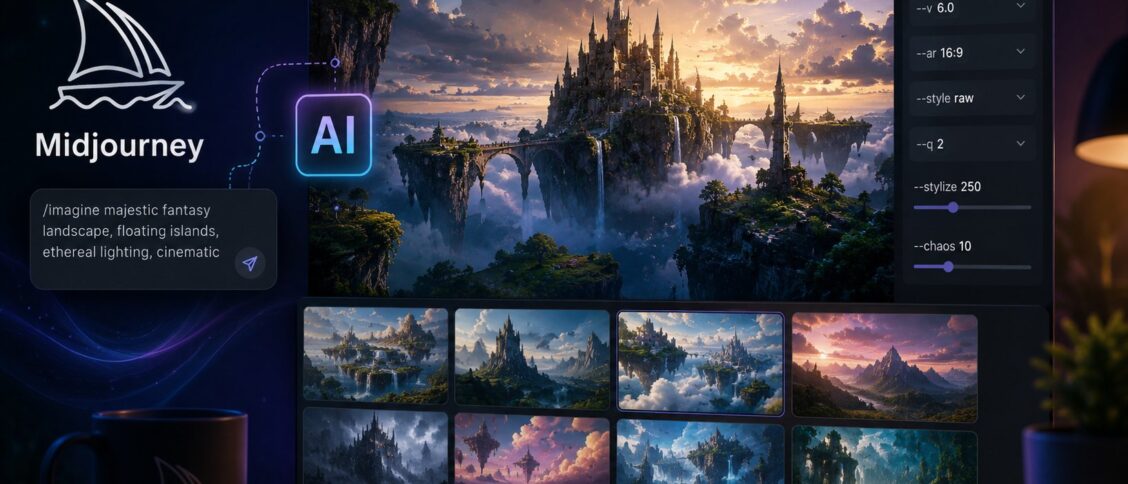
Midjourney AI art generation has, over the past 18 months, gone from research curiosity to genuinely useful production tool for marketing, design, and content workflows. The platform launched in public beta in March 2022 and reached general availability through 2023. By mid-2023, Midjourney is one of three major commercial AI image generators (alongside DALL-E and Stable Diffusion) and the one most commonly chosen by professional designers for its distinctive aesthetic and the quality of its output.
This post walks through what Midjourney actually is, how it differs from the alternatives, where it earns its place in real workflows, what it costs, and the limits worth knowing about before adopting it. For broader AI context, see our piece on what artificial intelligence is; for the underlying generative AI category, see our coverage in the AI section; for the machine learning techniques that power image diffusion models, our ML 101 piece covers the foundations.
What Midjourney actually is
Midjourney is an AI image generation service built by an independent research lab of the same name (founded 2021 by David Holz). Users submit a text prompt describing an image; the AI generates four variations of that image; the user can refine, upscale, or vary the results. As of August 2023, Midjourney is on version 5.2 of its model, which produces images with substantially better composition, anatomy, and prompt adherence than the earlier versions.
The architectural pattern (shared with other generative image models):
- Diffusion model: starts with random noise and iteratively refines it toward an image matching the prompt. The training data is hundreds of millions of image-caption pairs, which is what gives the model its understanding of visual concepts.
- Text-to-image conditioning: the prompt is processed by a language model that produces a representation the image model can use to guide generation. This is why prompt engineering matters; the way you describe what you want substantially shapes the output.
- Iterative refinement: Midjourney’s interface lets users vary, upscale, or remix initial outputs. The interactive loop is part of how production-quality images are created; one-shot generation is rarely the final output.
The product is delivered through Discord (the chat platform), which is a deliberate distribution choice. Users interact with the Midjourney bot in Discord channels, and the channel-based interface creates a public gallery of everyone’s generations alongside their own. The pattern produces a community learning effect (you see what prompts produce good images) that pure private interfaces would not.
How Midjourney differs from DALL-E and Stable Diffusion
Three commercial AI image generators dominate the market in mid-2023:
- Midjourney: distinctive aesthetic (often described as “cinematic” or “stylized realism”); excellent on composition and atmosphere; less prompt-literal than competitors. Strong for creative and marketing imagery. Discord-based interface.
- DALL-E 2 (OpenAI): better at prompt-literal interpretation (does what you say, not what looks good); more conservative in style; integrates with the OpenAI API and ChatGPT. Strong for product imagery, illustrations following specific requirements, and applications where prompt fidelity matters.
- Stable Diffusion (Stability AI): open-source, can be self-hosted, highly customizable through community-trained variants. Free at the model level (you pay for hosting/compute); strongest for developers and designers wanting maximum control and willing to manage the deployment.
The "best" generator depends on the use case. For marketing assets with a specific brand style, Midjourney often produces the most usable output. For product mockups requiring exact attribute control, DALL-E 2 may fit better. For workflow automation, Stable Diffusion’s API access (via Stability AI’s hosted service or self-hosted deployment) often wins.
Where Midjourney earns its place in real workflows
Three categories of use have emerged as production-viable:
- Marketing and content imagery: featured images for blog posts, social media graphics, ad concepts, landing page visuals. Replaces stock photography for many use cases at a fraction of the licensing cost and with much higher specificity to the content.
- Concept art and mood boards: rapid exploration of visual directions for design projects. A designer can generate dozens of concept variations in minutes that would have required hours of stock photo searching or initial sketching previously.
- Inspiration and reference: not as final output, but as creative input for human artists, designers, and illustrators. The pattern is “generate dozens of variations, identify what’s working, hand-craft from there.”
Use cases where Midjourney does not earn its place (yet):
- Brand-specific characters or products that need to look consistent across many images: Midjourney’s outputs vary substantially between generations. Without fine-tuning (not available in the standard product) or extensive prompt engineering, you cannot get reliable consistency.
- Text in images: Midjourney (and most generative image models in mid-2023) produces gibberish text within images. Logos, signs, captions, and labels need to be added after generation.
- Photorealistic human faces for commercial use: legal and ethical concerns around AI-generated human likenesses, plus current models’ difficulty with consistent realistic faces, make this a category to handle carefully.
- Hands and complex anatomy: AI image models notoriously struggle with hands, fingers, and complex anatomical details. Outputs improving but not solved.
What Midjourney costs
Midjourney’s pricing as of August 2023:
- Basic plan ($10/month): ~200 generations per month, slow queue, limited concurrency.
- Standard plan ($30/month): 15 hours of fast generation per month, unlimited slow generation, higher concurrency. The most common plan for individual professional users.
- Pro plan ($60/month): 30 hours fast, unlimited slow, stealth mode (generations not public in shared channels), 12 concurrent fast jobs.
- Mega plan ($120/month): 60 hours fast, everything else from Pro.
For a marketing team producing multiple images weekly, Standard or Pro is typically sufficient. For agencies or content operations producing dozens of images daily, Mega is often the right tier.
The economics: even at the Pro tier, the cost per usable image is typically a few cents to a few dollars depending on how many iterations are needed. Compared to stock photography licensing (often $10-50 per image) or custom illustration (typically $100+ per image), the cost advantage is significant for the categories where Midjourney earns its place.
What to know before adopting Midjourney
Three considerations for businesses evaluating Midjourney for production use:
Commercial use rights vary by plan. Free and basic plans have restrictions on commercial use. Paid plans (Standard and above) grant commercial usage rights. Verify the current terms of service before using outputs in commercial contexts; Midjourney’s terms have evolved over time.
Content policy enforcement. Midjourney enforces content policies (no explicit content, no violent imagery, no deepfakes of real people, limits on brand impersonation). The enforcement is mostly handled at the prompt level (some prompts get blocked) and at the output level (some outputs get flagged or removed). For commercial use, this enforcement is usually a benefit; for edge cases it can be frustrating.
Output variation requires craft. Producing usable images requires prompt engineering skill that takes time to develop. The first prompts a new user writes usually do not produce the best outputs. Training a team on Midjourney is a real investment, though much shorter than training on traditional design tools.
Update (2026-05-12): how the AI image generation landscape has evolved.
The fundamentals in the body of this post still hold. What has changed since August 2023 is the rapid evolution of the entire generative image and video category:
- Midjourney has continued to release new model versions: v6 (December 2023), then continued improvements through 2024 and 2025. Quality on previously-difficult areas (hands, text, anatomy, consistency) has improved substantially.
- DALL-E 3 (October 2023) integrated directly into ChatGPT, making image generation accessible to anyone with a ChatGPT subscription. The prompt-literal interpretation Sam Altman’s team emphasized has been refined further.
- Adobe Firefly has matured into a credible enterprise option with explicit commercial-rights clarity and Adobe Creative Suite integration.
- Generative video (Sora, Runway, Veo, others) has emerged as the next frontier. The patterns Midjourney pioneered in image generation now apply to short video clips.
- Stable Diffusion 3 and successors have continued the open-source thread, with the community trained-variant ecosystem now sufficient for most production needs.
- Pricing has trended down across all platforms as efficiency has improved.
- Brand-consistency tooling has improved: most major platforms now offer some form of fine-tuning or reference-image capability that addresses the "outputs vary too much" limitation that was real in 2023.
The use cases where Midjourney "earns its place" in this post remain essentially correct in 2026; the alternatives have all caught up and the category has expanded into video. The fundamental question of whether AI-generated imagery fits your workflow has answers that are usually "yes, for the categories listed here."
Frequently Asked Questions
Can I use Midjourney images commercially?
On paid plans (Standard, Pro, Mega), yes. Free and basic plans have restrictions. Always check Midjourney’s current terms of service, which have evolved over time. The pattern is: pay for a commercial-grade plan, you get commercial usage rights.
How does Midjourney compare to hiring a designer?
For specific categories of imagery (concept exploration, generic supporting visuals, social media graphics), Midjourney is faster and cheaper than custom design work. For brand-specific work, custom illustration, design that needs to integrate with broader visual systems, and any work requiring iteration with a human collaborator, designers remain essential. The realistic pattern is: designers use Midjourney as a tool within their workflow; Midjourney does not replace designers for serious work.
Is Midjourney’s use of training data legal?
The legal questions around AI training on copyrighted images are unresolved and actively being litigated as of mid-2023. The artist and rights-holder community has expressed substantial concern; multiple lawsuits are working through courts. The practical guidance for businesses using Midjourney commercially is to stay aware of the legal landscape, document the use, and consider whether your specific use case has elevated exposure.
What prompt engineering skills should I learn?
The basics: descriptive language about subject, composition, lighting, style, mood. Specific photographer or artistic style references that the model has learned from. Aspect ratio specification. Negative prompts (what to avoid). The Midjourney community publishes extensive prompt galleries that are useful for learning what produces what. Reading other people’s prompts on Midjourney’s Discord channels is the fastest learning path.
Can Midjourney produce my brand’s logo or my product?
With current capability (as of August 2023), reliably reproducing a specific logo or specific product look across many images is difficult. The model produces variations rather than consistent reproductions. For brand-sp