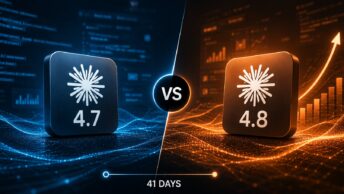
Claude Opus 4.8 is Anthropic’s latest frontier model, released on May 28, 2026 as an upgrade to Opus 4.7. It ships with a notable cluster of accompanying features: Dynamic Workflows in Claude Code (hundreds of parallel subagents in a single session, designed for codebase-scale migrations), an effort control dial on claude.ai and Claude Cowork that lets users decide how hard the model thinks on a given task, a fast mode that runs at 2.5× the speed of standard inference for three times lower cost than previous Opus fast modes, and a meaningfully sharper honesty profile (Anthropic’s own evaluations report Opus 4.8 is roughly four times less likely than 4.7 to let code flaws pass unremarked). Pricing for standard usage stays put at $5 per million input tokens and $25 per million output tokens. The API model identifier is claude-opus-4-8.
The release also closes a meaningfully shorter upgrade cycle than Anthropic typically runs: 41 days from Opus 4.7 to Opus 4.8, against three months between recent Sonnet refreshes and seven months between recent Haiku updates. That cadence is real news in its own right, and we’ll get to why below. This post is a foundational 101 for Opus 4.8: what it is, what’s new vs 4.7, how Dynamic Workflows changes Claude Code workflows, what the effort dial does, where the Mythos shadow factors in, and what the practical takeaways are for builders.
What Claude Opus 4.8 is
Opus is Anthropic’s flagship intelligence tier in the Claude family, sitting above Sonnet (Anthropic’s general-purpose default) and Haiku (the fast, lower-cost option for high-volume work). Opus 4.8 is the sixth release in the Claude 4 generation on the Opus track, following Opus 4 (May 2025), Opus 4.1 (Aug 5, 2025), Opus 4.5 (Nov 24, 2025), Opus 4.6 (Feb 5, 2026), and Opus 4.7 (Apr 16, 2026). Each Opus dot-release has been a real model rather than a cosmetic version bump; 4.8 continues that pattern with measurable gains across coding, agentic skills, reasoning, and computer-use benchmarks against 4.7.
What Opus is for hasn’t changed across these dot-releases. It’s the model you reach for when the task warrants the cost and latency of frontier intelligence: complex coding work that benefits from careful reasoning, multi-step agentic tasks where mistakes compound, long-running analytic workloads where signal-to-noise matters, professional knowledge work where the answer needs to be defensible rather than plausible. Anthropic positions Opus as the model for collaborators, in contrast to Sonnet’s positioning as the model for daily-driver throughput.
The model is available everywhere Anthropic ships Claude. That means claude.ai, the Claude apps (desktop, mobile, web), Claude Code, Claude Cowork, the Claude API, and the cloud partner endpoints (AWS Bedrock, Google Cloud’s Vertex AI, Microsoft Foundry). It’s also one of the supported models inside Google Antigravity, which means Opus 4.8 lands as a usable model inside Google’s own agentic IDE more or less the day it’s released.
What’s actually new vs Opus 4.7
Anthropic’s own framing is "modest but tangible." Reading the testimonials and benchmark commentary published in the launch post, the gains cluster around a few specific areas rather than a single headline number.
Coding judgment improves notably. Multiple early-tester quotes (Anthropic-published, so positively selected, but specific) emphasize judgment rather than raw capability: catching mistakes, pushing back on weak plans, building context before making large changes. Anysphere reports on CursorBench that Opus 4.8 exceeds prior Opus models across every effort level, with tool calling that uses fewer steps for the same intelligence. Cognition (the Devin team) specifically notes that 4.8 fixes the comment-verbosity and tool-calling issues Cognition saw in 4.7, which is an unusually direct admission of a real 4.7 regression now resolved.
Agentic reliability is up across multiple benchmarks. Mercor reports that on its Super-Agent benchmark, Opus 4.8 is the only model to complete every case end-to-end, beating prior Opus models and OpenAI’s GPT-5.5 at parity on cost. Browserbase reports 4.8 scoring 84% on Online-Mind2Web for computer-use and browser-agent tasks, calling it a "meaningful jump" over both Opus 4.7 and GPT-5.5.
Professional-domain accuracy improves where it’s measurable. Harvey reports the highest score yet recorded on its Legal Agent Benchmark, with Opus 4.8 the first model to break 10% on Harvey’s strict "all-pass" standard. Thomson Reuters’ CoCounsel Legal team echoes meaningful consistency and reasoning-quality gains for legal workflows. Hebbia reports better citation precision and token efficiency for retrieval over dense financial filings. Databricks reports that Opus 4.8 reasons over PDFs, diagrams, and unstructured content in its Genie product at 61% lower token cost than 4.7.
Honesty is the single most-emphasized non-benchmark improvement. Anthropic’s own evaluations report Opus 4.8 is "around four times less likely than its predecessor to allow flaws in code it has written to pass unremarked." Early testers (Bridgewater Associates specifically) report 4.8 "proactively flag[s] issues with the inputs and outputs of an analysis, something other models routinely missed and left to the users to catch." Anthropic’s alignment team adds that 4.8 reaches "new highs on our measures of prosocial traits like supporting user autonomy and acting in the user’s best interest," with misaligned-behavior rates substantially lower than 4.7 and similar to Anthropic’s best-aligned model, Claude Mythos Preview.
The honest summary: nothing here is a 10× capability jump. The right way to read 4.8 is as a quality-of-life and reliability upgrade on the dimensions that affect day-to-day collaboration with the model, plus solid benchmark gains across the agentic and computer-use surfaces where Anthropic has been investing most aggressively.
Dynamic Workflows: hundreds of parallel subagents in Claude Code
The most architecturally interesting thing shipping with Opus 4.8 is Dynamic Workflows, a research-preview feature available in Claude Code for Enterprise, Team, and Max plan customers. The mechanic: Claude plans a complex task, spawns hundreds of parallel subagents to execute pieces of it in a single session, verifies the outputs of those subagents, and then reports back. Each subagent runs independently; the parent Claude coordinates.
The motivating example Anthropic published is codebase-scale migration. Claude Code with Opus 4.8 plus Dynamic Workflows can now carry out migrations across hundreds of thousands of lines of code from kickoff to merge, with the existing test suite as the verification bar. Translate that to practice: you point Claude at a large repository, describe the migration (a framework upgrade, a library swap, an API-shape change, a deprecation cleanup), and Claude orchestrates the work as a coordinated swarm rather than a single agent grinding through files sequentially. The verification step is the substantive part: the parent Claude doesn’t trust subagent outputs on faith, it runs the tests and confirms before reporting completion.
This is the same general direction Google Antigravity‘s Manager view points (orchestrate multiple agents in parallel) and that OpenAI Codex’s various scaling efforts have been heading. The differences are in implementation. Antigravity’s Manager surface caps at five parallel agents and treats parallelism as a human-supervisable fleet. Dynamic Workflows in Claude Code goes for hundreds of parallel subagents inside a single agent session with the parent Claude doing the supervision. Both approaches are coherent, and which one fits a given team depends on whether you want humans or models in the verification loop.
A couple of operational notes worth flagging. Dynamic Workflows is research preview, which means the feature surface is expected to change. It’s gated to the higher-tier Claude Code plans (Enterprise, Team, Max) rather than rolling out to free or Pro Claude Code users immediately. Rate limits in Claude Code were increased alongside the launch to accommodate the heavier token use of the swarm pattern.
Effort control: a new dial on the model selector
The second user-facing addition is effort control on claude.ai and Claude Cowork, available on all plans. The control sits next to the model selector and lets you choose how much effort Claude puts into a response. Higher effort = more thinking, deeper analysis, generally better answers, more tokens consumed (and more of your rate-limit window used). Lower effort = faster responses, leaner token usage, more headroom in your rate limit.
In Claude Code, the effort levels are exposed as four named settings: the default ("high"), plus "extra" (named xhigh in CLI), and "max." Anthropic’s published guidance is that the default high setting is the best overall balance of quality and user experience, and that on coding tasks it consumes a similar number of tokens to Opus 4.7’s default while delivering measurably better results. The extra and max settings spend more tokens to push quality further; Anthropic recommends extra specifically for difficult tasks and long-running asynchronous workflows.
The deeper significance of effort control is that the user is no longer choosing only the model. They’re choosing the model and the effort level on a per-task basis. The same Opus 4.8 instance can run faster and lighter when you’re iterating on a wording change, then deeper and harder when you’re working through a complex refactor. This is a meaningful UI shift away from the "switch to a smarter model when you need to" pattern and toward "stay on the right model, dial the effort."
Fast mode: 2.5× the speed, three times cheaper than before
Opus’s fast mode (introduced in earlier 4.x releases) has been substantially reworked. Opus 4.8 in fast mode runs at 2.5× the speed of standard inference, and the per-token cost of fast mode is now three times cheaper than fast mode was for the previous Opus generation. Pricing concretely: standard Opus 4.8 is $5 per million input tokens and $25 per million output tokens (unchanged from 4.7). Fast mode Opus 4.8 is $10 per million input tokens and $50 per million output tokens.
The math worth working through: fast mode is still 2× more expensive than standard mode per token, but you’re getting that token output 2.5× faster, and the absolute cost of using fast mode is now substantially lower than using fast mode on prior Opus models. For latency-sensitive workloads (live coding assistance, interactive analysis, agent loops where each step’s latency compounds across many steps), fast mode becomes economically viable for workloads where it previously made more sense to drop down to Sonnet or take the latency hit on standard Opus.
The strategic read is that Anthropic is bidding to keep frontier-intelligence pricing in a range that makes sense for agentic workloads that previously had to choose between "smart but slow" and "fast but less capable." Fast mode at the new pricing changes that trade-off.
A quieter but important change: system entries in the Messages API
Less attention-grabbing but architecturally significant: the Anthropic Messages API now accepts system entries inside the messages array. Previously, the system prompt was a separate top-level field, set once at the start of a conversation. With this change, developers can inject new system-level instructions mid-conversation without breaking the prompt cache and without having to route those updates through a user-turn message.
The use cases are agentic. Permissions can be updated as an agent gains or loses access to a tool. Token budgets can be tightened or loosened as a task evolves. Environment context (the working directory, the active branch, the open tab) can be communicated to the model as it changes. None of those operations have a natural home in a user message; they’re harness-level signals. This API change gives them the right shape.
For teams building on the Claude API, this is the kind of change that doesn’t get a headline but quietly improves the ergonomics of building production agentic systems on top of Claude.
The Mythos shadow
The other meaningful piece of context Anthropic dropped in the launch post is what’s coming after Opus. Project Glasswing’s Claude Mythos Preview is a higher-intelligence model class than Opus, currently in use by a small number of organizations for cybersecurity work, and gated by the need for stronger cyber safeguards before general release. Anthropic’s own published claim: "We’re making swift progress on developing these safeguards and expect to be able to bring Mythos-class models to all our customers in the coming weeks."
That has two implications worth holding in your head while evaluating Opus 4.8. First, the Mythos timeline matters for capacity planning if you’re building serious long-horizon agentic workloads; you’ll likely want Mythos when it lands, and "coming weeks" is short enough that adopting Opus 4.8 with an eye on Mythos is reasonable. Second, Anthropic’s alignment team explicitly cited Mythos Preview as the reference point for Opus 4.8’s improved misalignment numbers ("similar to our best-aligned model, Claude Mythos Preview"), which is informative about both 4.8’s quality and Mythos’s positioning.
Why the cycle got faster
This is the part of the release that’s news in itself. Opus 4.8 shipped 41 days after Opus 4.7. The last two Sonnet refreshes were three months apart; the last two Haiku refreshes seven months apart. A 41-day Opus cycle is a real acceleration.
Two contributors look credible from the outside. The first is competitive pressure. OpenAI’s Codex saw significant new releases in the interval. Google shipped Gemini 3.5 Flash at I/O on May 19, 2026 with frontier coding and agentic benchmarks (76.2% on Terminal-Bench 2.1; 83.6% on MCP Atlas). When the rest of the field ships, Anthropic is incentivized to match the cycle rather than wait. The second is that Opus 4.7 itself drew a mixed reception, including in public commentary on X and LinkedIn. A faster follow-up gets in front of any narrative that says 4.7 represented a slowdown.
Both pressures are real and neither contradicts the technical claim that 4.8 is a meaningfully better model than 4.7. The takeaway for builders evaluating the cycle: expect Opus refreshes on a faster cadence than Anthropic ran in 2025, and plan model-tracking work accordingly. The era of "set and forget the model version for six months" appears to be ending across the frontier-model providers generally; Anthropic is now matching the rhythm.
How to access Opus 4.8
Anthropic’s standard distribution applies. The model is available immediately across:
The consumer surfaces (claude.ai web app, the Claude mobile apps for iOS and Android, the Claude desktop apps for macOS and Windows). The effort dial appears next to the model selector on all plans.
The developer surfaces (the Claude API at claude-opus-4-8 as the model identifier; the Claude API console; the Anthropic SDKs for Python, TypeScript, Java, and Go). Pricing is $5/$25 per million input/output tokens standard, $10/$50 fast mode. The Messages API supports mid-conversation system entries with this release.
The agentic developer surfaces (Claude Code across CLI, VS Code, JetBrains, and the desktop app; Dynamic Workflows specifically in Claude Code on Enterprise, Team, and Max plans).
The cloud partner surfaces (AWS Bedrock, Google Cloud Vertex AI, Microsoft Foundry). And the third-party agent platforms that integrate Anthropic models, including Google Antigravity, which supports Opus 4.6 today and is expected to add Opus 4.8 on its usual refresh cadence.
For the broader Claude product family context, our Claude Code vs OpenAI Codex comparison covers the agentic CLI tooling that pairs naturally with Opus 4.8 for coding workflows, and our AI agents pillar covers the foundations of the agentic-AI category Opus 4.8 is built to serve.
What this means for builders
A few practical takeaways for the people who’ll be deciding whether and how to adopt 4.8 over the next few weeks.
- If you were on Opus 4.7 and avoiding Sonnet for quality reasons, the upgrade is essentially free (same pricing, same API call shape, same model identifier convention). Switch and run your evals.
- If you were running long-horizon coding agents and finding Claude was confidently wrong in subtle ways (the “honesty” cluster of complaints), 4.8 is specifically designed to address that. Re-test the prompts where 4.7 disappointed.
- If you’re operating Claude Code on an Enterprise, Team, or Max plan, Dynamic Workflows is the new capability worth piloting on a real codebase migration or large refactor. It’s research preview, so build with the expectation that the feature surface will evolve, but the codebase-scale claim is the right capability for the right workload.
- If you’re building on the Claude API and your agent harness has been wedging system-level updates into user messages, refactor to use the new system entries in the Messages array. Cleaner, doesn’t break prompt cache, doesn’t pollute the user-turn history.
- If your workload is latency-sensitive but quality-bounded, re-evaluate fast mode. The new fast-mode pricing makes it economically reasonable for workloads where it previously didn’t pencil out.
- If your work needs the highest available intelligence (cybersecurity, complex research, the workloads Project Glasswing is targeting), Opus 4.8 is the right model today, but plan for a Mythos evaluation cycle in the coming weeks. The transition is signaled.
The deeper takeaway is that the frontier model providers are now shipping on a faster, more incremental cadence than the field had been running on through 2024-2025. Opus 4.8 is an example, not an outlier. Building practices that assume the model layer is stable for six to twelve months are increasingly out of step with how the actual model layer behaves. The pragmatic response is investment in evaluation infrastructure, model-version-aware deployment tooling, and the kind of model-mix flexibility (route this workload to Opus, route that one to Sonnet) that makes frequent upgrades a feature rather than a tax.
Frequently Asked Questions
What is Claude Opus 4.8?
Claude Opus 4.8 is Anthropic’s latest frontier model, released on May 28, 2026. It’s the sixth release in the Claude 4 generation on the Opus track (Opus 4, 4.1, 4.5, 4.6, 4.7, 4.8), succeeding Opus 4.7 by just 41 days. Opus is Anthropic’s flagship intelligence tier, positioned above Sonnet (general-purpose default) and Haiku (fast, lower-cost). Opus 4.8 ships with measurable gains across coding, agentic, computer-use, and professional-domain benchmarks, along with a meaningfully sharper honesty profile.
How much does Claude Opus 4.8 cost?
Standard usage is $5 per million input tokens and $25 per million output tokens, unchanged from Opus 4.7. Fast mode is $10 per million input tokens and $50 per million output tokens, which is three times cheaper than fast mode was on previous Opus models. The API identifier is `claude-opus-4-8`.
What are Dynamic Workflows in Claude Code?
Dynamic Workflows is a new Claude Code feature, available in research preview, that lets Claude plan a complex task and run hundreds of parallel subagents in a single session to execute it. The parent Claude verifies the subagents’ outputs (against the existing test suite, for codebase migrations) before reporting back to the user. The motivating example is codebase-scale migrations across hundreds of thousands of lines of code from kickoff to merge. Dynamic Workflows is available on the Enterprise, Team, and Max Claude Code plans.
What does the new effort control on claude.ai and Cowork do?
The effort control is a new dial next to the model selector that lets you choose how much effort Claude puts into a response. Higher effort means more thinking, deeper analysis, generally better answers, and more token usage. Lower effort means faster responses and lighter use of your rate limit. In Claude Code, the levels are exposed as default (“high”), “extra” (`xhigh`), and “max.” Anthropic recommends the default for most tasks and “extra” for difficult tasks or long-running asynchronous workflows. The effort control is available on all plans.
How is Claude Opus 4.8 different from Opus 4.7?
The headline differences: 4× less likely to allow code flaws to pass unremarked (per Anthropic’s own evaluations); better coding judgment (catching mistakes, pushing back on weak plans, building context before large changes per CursorBench and Cognition’s testing); only model to complete every case end-to-end on Mercor’s Super-Agent benchmark; 84% on Online-Mind2Web for computer-use tasks (a meaningful jump over 4.7 per Browserbase); highest recorded score and first to break 10% on Harvey’s Legal Agent all-pass standard; 61% lower token cost than 4.7 for multimodal work in Databricks Genie; misaligned-behavior rates substantially lower than 4.7. None of those are 10× jumps; collectively they’re a real upgrade.
Why did Opus ship so quickly after 4.7 (only 41 days)?
Two factors look credible. First, competitive pressure: OpenAI’s Codex saw significant releases in the interval, and Google shipped Gemini 3.5 Flash at I/O on May 19, 2026 with frontier coding and agentic benchmarks. Second, Opus 4.7 drew a mixed reception (with public complaints on X and LinkedIn about regressions), and a faster follow-up gets in front of any narrative that 4.7 represented a slowdown. Both are real pressures and neither contradicts the technical claim that 4.8 is a meaningfully better model than 4.7. The broader takeaway: expect faster Opus refresh cycles going forward.
What’s Claude Mythos Preview and when does it become generally available?
Mythos is a new class of model with higher intelligence than Opus, developed under Anthropic’s Project Glasswing initiative. It’s currently in use by a small number of organizations for cybersecurity work, and gated by the need for stronger cyber safeguards before general release. In the Opus 4.8 launch post, Anthropic stated they’re “making swift progress on developing these safeguards and expect to be able to bring Mythos-class models to all our customers in the coming weeks.” For workloads that need the highest available intelligence, Opus 4.8 is the right model today; a Mythos evaluation cycle is reasonable to plan for the near term.
How do I access Claude Opus 4.8?
Opus 4.8 is available immediately across Anthropic’s standard distribution: claude.ai (web), the Claude mobile and desktop apps, Claude Code (CLI plus IDE integrations), Claude Cowork, the Claude API (model identifier `claude-opus-4-8`), and the cloud partner endpoints on AWS Bedrock, Google Cloud Vertex AI, and Microsoft Foundry. Third-party agent platforms that integrate Anthropic models (including Google Antigravity) typically add new Opus releases on their own refresh