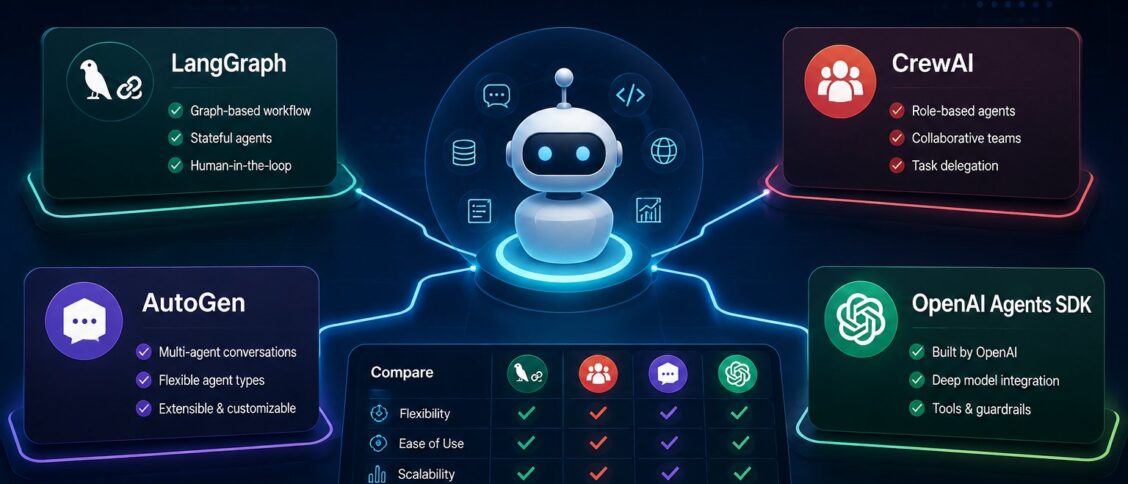
AI agent frameworks are the libraries and runtimes that let developers build, orchestrate, and operate autonomous agents on top of large language models. The framework market in 2026 has consolidated around four real choices: LangGraph (from LangChain), CrewAI, Microsoft AutoGen, and the OpenAI Agents SDK (which replaced the deprecated Swarm in March 2025). Each one optimizes for a different audience and a different mental model of how multi-agent work should be structured. The right choice depends less on which framework is "best" in some absolute sense and more on which mental model matches the work you’re trying to do.
This post is the first satellite in our AI Agents content series, anchored by the AI Agents practitioner’s guide pillar. It walks through what an agent framework actually is, the four major options in May 2026, their architectural and operational trade-offs, and a decision framework for picking the right one. For background on the underlying model layer powering these frameworks, see our pieces on GPT-5.5 and DeepSeek V4 Pro.
What an AI agent framework actually is
An AI agent framework is a runtime plus a programming model. The runtime handles the mechanics of executing an agent: calling the model, parsing tool calls, executing tools, managing state, handling errors, and looping back for the next decision. The programming model is the abstraction the developer uses to express what the agent should do: prompts and roles in some frameworks, graph nodes and edges in others, conversational turns in others.
Without a framework, building an agent means hand-rolling the loop: call the model, parse the response, dispatch any tool calls, handle errors, accumulate context, decide whether to continue. That works for a single-purpose agent but doesn’t scale to multi-agent systems, durable workflows, observability, or any non-trivial production deployment. Frameworks exist to handle the operational scaffolding so the developer can focus on the agent’s behavior.
The four frameworks covered here are all open-source. They differ in architectural philosophy, learning curve, production-readiness, and the kinds of agentic patterns they make easy versus hard.
The four major frameworks at a glance
- LangGraph: stateful graph-based orchestration from the LangChain team. Models agents as nodes in a directed graph with shared state. Built for explicit control flow, durable long-running workflows, and human-in-the-loop oversight. Best fit for production multi-agent systems with audit and rollback requirements.
- CrewAI: role-based agent teams. Defines agents as characters with roles, goals, and tools; orchestrates them via tasks that they collaborate on. Optimized for development speed. Best fit for fast-assembly business workflows where time-to-prototype matters most.
- Microsoft AutoGen: conversational multi-agent framework from Microsoft Research. Agents interact through structured conversations (group debates, sequential dialogues, consensus-building). Microsoft’s strategic focus has shifted toward the broader Microsoft Agent Framework, but AutoGen continues to receive security patches and bug fixes.
- OpenAI Agents SDK: OpenAI’s production-grade agent framework, released March 2025 as the successor to the deprecated Swarm educational framework. Currently at v0.17.1 (May 2026) with 26k+ GitHub stars. The framework OpenAI uses in its own examples and customer references.
A note on Swarm: OpenAI Swarm was an educational, lightweight multi-agent orchestration framework released October 2024. It was popular for prototyping but never positioned for production use. Per its current GitHub README, Swarm is deprecated and the repository redirects users to the OpenAI Agents SDK. If you encounter Swarm in older tutorials or blog posts, treat any production guidance with skepticism.
LangGraph: explicit state and control flow
LangGraph is the most architecturally rigorous of the four. Agents are nodes in a directed graph; edges represent transitions between agent states; state is shared across the graph and explicitly managed. The framework is built on top of LangChain but is now used independently of LangChain in many production deployments.
The defining strengths:
- Durable long-running workflows: the graph runtime can pause and resume execution across hours or days. State persists between invocations.
- Human-in-the-loop (HITL): pause the graph, wait for human input (approval, clarification, data), resume with the new context. First-class capability rather than a bolt-on pattern.
- Time-travel debugging: replay the graph from any prior state to investigate what an agent did and why.
- Audit trails: every state transition is recorded, making compliance and post-incident review tractable.
LangGraph surpassed CrewAI in GitHub stars during early 2026, driven primarily by enterprise adoption. The graph mental model maps cleanly to production requirements (audit, rollback, HITL) that less rigorous frameworks make awkward. The official LangGraph documentation reflects the framework’s production posture, with detailed coverage of persistence backends (Postgres, Redis), distributed graph execution, and observability via LangSmith.
The trade-offs: the learning curve is steep. The graph abstraction takes meaningful time to internalize (typical reports cite 10–14 days for a competent developer to become productive). For simple single-agent or two-agent workflows, the framework feels like over-engineering. LangGraph rewards investment; it punishes minimum-viable use.
Best fit: production multi-agent systems with formal requirements (audit, HITL, rollback). Long-running workflows where state durability matters. Teams that are willing to invest in the graph mental model upfront.
CrewAI: role-based teams for fast assembly
CrewAI takes a different philosophical bet. Instead of explicit state and graph control flow, agents are defined as characters with roles ("research analyst," "writer," "fact-checker"), goals, and tools. The framework orchestrates them by assigning tasks and managing inter-agent collaboration.
The defining strengths:
- Development speed: a working CrewAI demo takes 2–3 engineer-days for most use cases. The role-based abstraction is intuitive enough that non-AI-specialist developers can build with it.
- Business workflow fit: the role-based mental model matches how non-technical stakeholders describe what they want (“I want an analyst agent, a writer agent, and a reviewer agent”). The framework is easy to demo to executives.
- Growing A2A protocol support: CrewAI has added support for the Agent-to-Agent protocol, which makes multi-agent systems built in CrewAI more interoperable with agents built elsewhere.
The trade-offs: less mature monitoring and observability tooling than LangGraph or the OpenAI Agents SDK. Production deployments are common but the framework’s center of gravity is "fast prototype to mid-scale production" rather than "regulated enterprise at scale." For workloads that need formal audit trails, HITL discipline, or rollback capability, CrewAI requires more custom work than LangGraph.
Best fit: business-workflow agents that need to ship fast. Role-based mental model matches the use case. Prototype-to-production within the same framework without rewriting. The CrewAI documentation is one of the most accessible in the agent framework space, with role-and-task examples that map directly to how non-AI-specialist developers think about the work.
Microsoft AutoGen: conversational multi-agent
AutoGen is the multi-agent framework that came out of Microsoft Research in 2023 and quickly became one of the most popular open-source agent frameworks. Its defining mental model is conversation: agents interact by talking to each other in structured patterns (group chats, sequential dialogues, debate, consensus-building).
The defining strengths:
- Conversation pattern depth: AutoGen offers the most diverse set of conversation patterns of any framework. Group debate, sequential expert consultation, consensus voting, hierarchical delegation are all first-class patterns.
- Microsoft ecosystem integration: native compatibility with Azure OpenAI, Microsoft 365 integration patterns, and the broader Microsoft AI stack.
- Research lineage: AutoGen continues to be the framework used in much of Microsoft Research’s multi-agent academic work, which keeps it on the experimental frontier.
The trade-offs: Microsoft has shifted strategic focus toward the broader Microsoft Agent Framework, which subsumes AutoGen’s positioning. Major new feature development on AutoGen specifically has slowed. The framework receives bug fixes and security patches but is no longer the area of heaviest Microsoft investment. For organizations evaluating AutoGen for new production work in 2026, the question is whether Microsoft Agent Framework would be the better long-term commitment.
Best fit: multi-agent systems where the work pattern is genuinely conversational (debate, consensus, sequential expert consultation). Organizations already invested in the Microsoft AI ecosystem. Research-oriented work where AutoGen’s academic momentum matters. The Microsoft AutoGen project page reflects the current state, including the relationship between AutoGen and the broader Microsoft Agent Framework.
OpenAI Agents SDK (and the deprecated Swarm)
The OpenAI Agents SDK launched March 2025 as OpenAI’s production-grade agent framework, replacing the educational Swarm. Per the GitHub repository, Swarm is now deprecated; new development should use the Agents SDK.
The defining strengths:
- Built-in tracing: every agent run produces a structured trace inspectable in the OpenAI dashboard or exportable via OpenTelemetry. Production observability without bolt-on instrumentation.
- Guardrails: pre- and post-tool callbacks for input validation, output checking, content filtering, and cost ceilings. Production-grade safety controls as a framework feature.
- Active OpenAI maintenance: the SDK is the framework OpenAI uses in its own examples and customer references, which means new model features and capabilities land in the SDK first.
- Maturity: at v0.17.1 with 26k+ GitHub stars (May 2026), the SDK is past the bleeding-edge phase and has accumulated production patterns.
The trade-offs: tighter coupling to OpenAI as the model provider. The SDK works with any OpenAI-API-compatible model (including OpenRouter, Together, vLLM-hosted models) but the framework’s primary design assumption is OpenAI’s model line. For organizations standardizing on Claude or Gemini as their primary model, the framework adds friction relative to LangGraph or CrewAI.
Best fit: production agents primarily on OpenAI models. Workloads where built-in tracing and guardrails are operational priorities. Teams that want OpenAI’s official framework rather than a third-party. The OpenAI Agents SDK documentation covers the framework’s core abstractions (Agent, Tool, Runner, Guardrail) and the integration with OpenAI’s broader API surface.
How to choose: a decision framework
A pragmatic decision rubric, in order:
1. Is your work pattern conversational (debate, consensus, sequential expert consultation)? AutoGen is purpose-built for this. CrewAI’s role-based pattern is the second-best fit.
2. Do you have formal production requirements (audit trails, HITL, rollback, durable long-running workflows)? LangGraph. The investment in the graph mental model pays back at production scale.
3. Is time-to-prototype the dominant constraint? CrewAI. Two to three engineer-days to a working demo is genuinely faster than the alternatives.
4. Are you committed to OpenAI as the primary model provider? OpenAI Agents SDK gives you first-class access to OpenAI features and built-in tracing.
5. Are you in the Microsoft ecosystem and starting fresh? Consider the Microsoft Agent Framework as well as AutoGen. Microsoft’s strategic focus has shifted; the Agent Framework is where new Microsoft investment is landing.
For most mid-market organizations starting a first serious agent project in 2026, the realistic choice is between CrewAI (fastest to demo, mid-tier production) and LangGraph (steeper curve, stronger production posture). The OpenAI Agents SDK is the right answer for OpenAI-committed deployments; AutoGen is the right answer for conversational multi-agent work or research-oriented projects.
The framework choice is also not permanent. Agents built in one framework can typically be migrated to another with moderate effort, especially as the A2A protocol (now supported by CrewAI and several other frameworks) makes cross-framework interoperability easier. Pick what fits the next 12 months; revisit when the framework market or your requirements shift.
For broader context on the agent capability shift, our AI Agents pillar covers what agents actually do; our Microsoft Copilot Studio recap covers the enterprise-grade agent-building platform that sits alongside these code-first frameworks.
Frequently Asked Questions
Should I still use OpenAI Swarm?
No. Swarm is deprecated. The GitHub README points users to the OpenAI Agents SDK for any production use. OpenAI has not updated the Swarm repository since March 2025; bug reports and PRs are not being triaged. Swarm remains useful for learning and prototyping due to its clean code, but it should not be used for new production work. If you have an existing Swarm-based system, plan a migration to the Agents SDK.
Can I use these frameworks with non-OpenAI models?
Yes, with varying degrees of friction. LangGraph and CrewAI are model-agnostic by design and work with OpenAI, Anthropic Claude, Google Gemini, open-source models via vLLM or Ollama, and local models. AutoGen supports OpenAI and Azure OpenAI most directly but has community integrations for other providers. The OpenAI Agents SDK is OpenAI-API-shaped, which means it works with any OpenAI-compatible endpoint (Together, OpenRouter, vLLM) but the framework’s primary design assumption is OpenAI’s model line.
What’s the difference between an agent framework and a low-code agent builder like Microsoft Copilot Studio?
Agent frameworks (the four covered here) are code-first developer libraries. You write Python or TypeScript to define agents and orchestrate them. Low-code agent builders like Microsoft Copilot Studio give business users a visual interface to define agents without writing code, with a managed runtime, enterprise governance, and platform integrations built in. The two categories aren’t substitutes; they target different audiences. A serious enterprise agent strategy in 2026 typically uses both: code-first frameworks for developer-built agents, low-code builders for business-built agents.
How long does it take to become productive with each framework?
Rough industry estimates: CrewAI productive in 2–3 days for a working demo, 1–2 weeks for confident production use. AutoGen productive in 5–7 days. OpenAI Agents SDK productive in 5–7 days. LangGraph productive in 10–14 days due to the graph mental model. The learning curve correlates with the architectural depth: frameworks that make more decisions for